title: “Ruflo: Command an AI Special Forces Team with Claude” description: “Ruflo is a multi-agent orchestration platform built for Claude — coordinate swarms of specialized AI agents to tackle complex engineering projects with intelligent cost routing, vector memory, and spec-driven quality control.” tags: [Claude, AI Agents, Multi-Agent, Open Source, Developer Tools, Claude Code, MCP] date: 2026-03-01
🌊 Ruflo: Command an AI Special Forces Team with Claude
Open Source | Multi-Agent Orchestration | Claude Ecosystem
1. What Problem Does It Solve?
Anyone who has worked with Claude Code on a serious project will recognize these frustrations: a single AI simply isn’t enough for complex work.
- Context windows can’t hold large codebases
- Implementations slowly drift away from the original design docs
- Every task blindly calls the most expensive model, sending costs through the roof
- Multiple tasks must queue up serially, killing throughput
- No persistent memory — every new session means starting from scratch
Ruflo was built to address every one of these pain points.
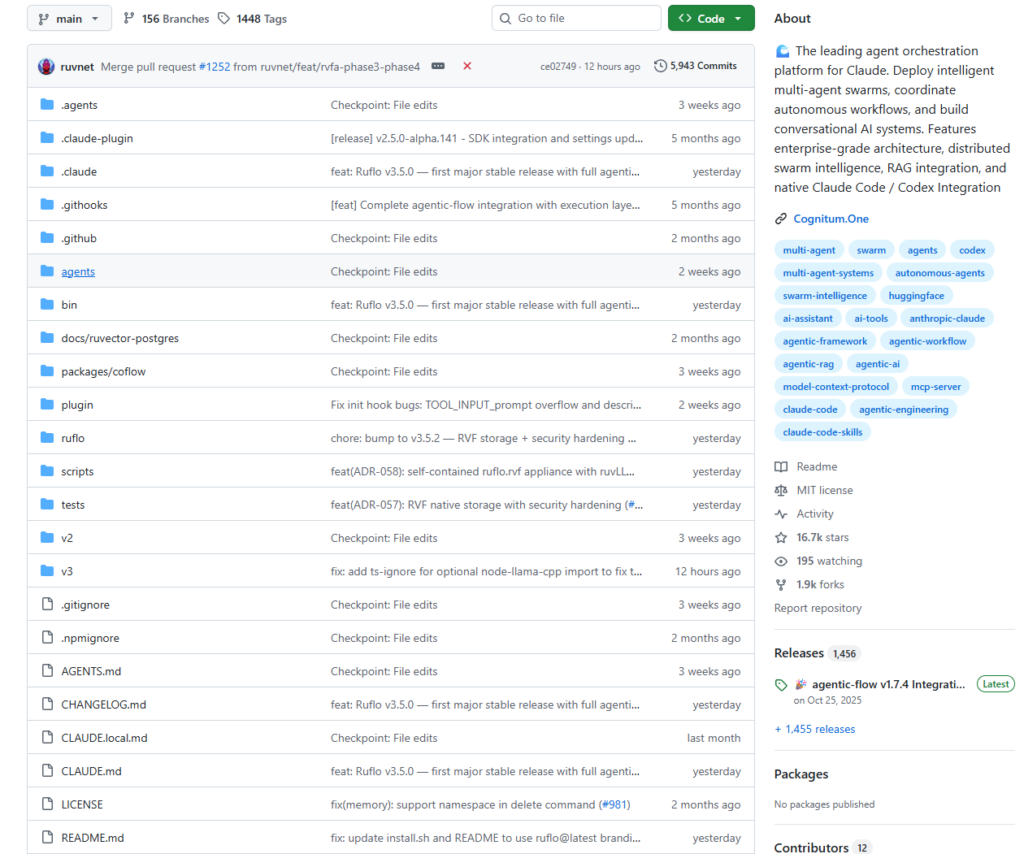
Ruflo (formerly Claude Flow) is the result of 10 months of development, 5,800+ commits, and 55 alpha iterations. The v3.5.0 stable release has now crossed 16,000 GitHub stars, is approaching 500,000 total downloads, and is actively used by developers in more than 80 countries every month.
2. What Is Ruflo?
Ruflo is a multi-agent orchestration platform purpose-built for Claude. The one-sentence pitch:
It lets you coordinate a squad of specialized AI agents — like commanding a special forces unit — to collaboratively tackle complex development tasks.
Core Capabilities
① Agent Swarms
Ruflo can simultaneously spawn multiple role-specific agents: coder, tester, reviewer, architect, and more. They operate in a hierarchical topology, processing tasks in parallel and cross-validating each other’s outputs.
② Intelligent Cost Routing
Not every task needs Opus. Ruflo’s built-in task analyzer routes work intelligently:
- Simple code transformations → skip the LLM entirely, handle via WebAssembly
- Medium-complexity tasks → route to a faster, cheaper model
- Complex architectural decisions → escalate to Claude Opus
③ Spec-Driven Drift Prevention
The biggest risk on long projects is implementation slowly diverging from the design. Ruflo integrates ADR (Architecture Decision Records) and DDD (Domain-Driven Design) practices so agents always work against a defined specification — with automatic rollback when deviations are detected.
④ High-Speed Vector Memory
Powered by HNSW indexing, Ruflo’s memory search runs at 150× the speed of conventional approaches. Agents can store and retrieve development patterns, authentication schemes, project conventions, and best practices — genuinely “remembering” how your project works.
⑤ Self-Learning Hooks
After each completed task, the system automatically captures learnings and refines future routing decisions. The more you use it, the smarter it gets.

3. How to Use It
Installation & Initialization
No global install required — just use npx:
# Launch the interactive setup wizard
npx ruflo@latest init --wizard

# Run a system health check (auto-fixes common issues)
npx ruflo doctor --fix
Initialization automatically generates .claude/settings.json and helper scripts, and surfaces real-time model usage, context consumption, and cost estimates in the Claude Code status bar.
Integrating with Claude Code / Claude Desktop
# Register Ruflo as an MCP server
claude mcp add ruflo -- npx -y ruflo@latest
Or add it manually to Claude Desktop’s settings.json:
{
  "mcpServers": {
    "ruflo": {
      "command": "npx",
      "args": ["-y", "ruflo@latest"]
    }
  }
}
Launching an Agent Swarm
# Start the background daemon
npx ruflo daemon start

# Initialize a hierarchical swarm (up to 8 agents)
npx ruflo swarm init --topology hierarchical --max-agents 8

# Spawn specialized agents
npx ruflo agent spawn -t coder --name my-coder
npx ruflo agent spawn -t tester --name my-tester
npx ruflo agent spawn -t reviewer --name my-reviewer
Working with Vector Memory
# Store a development pattern
npx ruflo memory store --key "auth-pattern" --value "JWT with refresh tokens" --namespace patterns

# Search with 150× speed boost
npx ruflo memory search --query "authentication" --limit 5
Security Scanning
npx ruflo security scan --depth full
HiveMind Advanced Mode (New in v3.5.0)
# Initialize a hierarchical mesh topology with Byzantine consensus
npx ruflo hive-mind init --topology hierarchical-mesh --consensus byzantine

# Deploy 8 specialized agents
npx ruflo hive-mind spawn --agents 8 --strategy specialized
4. Summary
| Dimension | Single Agent (Traditional) | Ruflo Multi-Agent Orchestration |
|---|---|---|
| Context | Limited to one window | Distributed across agents — no size limits |
| Cost | Always calls the most expensive model | Intelligent routing, downgrade as appropriate |
| Speed | Serial processing | Parallel swarms — dramatically faster |
| Quality | Prone to drift | Spec-driven with automatic rollback |
| Memory | Forgotten at session end | Persistent HNSW vector memory |
Ruflo isn’t a “plugin” for Claude — it’s a genuine upgrade that transforms Claude into a coordinated engineering team capable of delegating work, collaborating across roles, and self-correcting when things go off course.
For developers working on large projects, optimizing for cost efficiency, or already experimenting with Claude Code, Ruflo deserves a place in your toolbox.
GitHub: https://github.com/ruvnet/ruflo
# Try it in one line
npx ruflo@latest init --wizard
This article is based on Ruflo v3.5.0 stable release. The project is under active development.