While everyone else is still tweaking the same “all-purpose prompt,” some people are already running a fully staffed AI team with clearly defined roles — and shipping faster than ever.
1. Sound Familiar? The Pain of the “Do-Everything” AI
You fire up Claude Code to write some code. One moment you’re squashing a bug, the next you’re asking it for marketing copy, then reviewing a UI design — all in the same context window. The result? Everything gets done, but nothing gets done well.
That’s the fundamental problem with general-purpose AI: it can do everything, but it specializes in nothing.
What if your AI could work more like a real company — with a dedicated frontend engineer, a UI designer, a growth hacker — where each role brings its own deep expertise to the table? How much better would the output be?
That’s exactly the problem agency-agents was built to solve.
2. What Is agency-agents?
agency-agents is an open-source GitHub project with 6,000+ stars, created by developer Michael Sitarzewski. It originated from a Reddit thread about specializing AI agents — the first version received responses from 50+ Redditors within 12 hours of posting.
The core idea is elegantly simple:
Compress the capabilities of an entire professional team into a set of directly callable AI Agent configuration files.
Each agent is a single .md file containing:
- 🎯 Deep specialization — a vertical focus, not a generic prompt template
- 🧠 Distinct personality — its own communication style and working approach
- 📋 Outcome orientation — clear deliverables and measurable success criteria
- ✅ Production-ready — workflows refined through real-world projects
The project is licensed under MIT — free for commercial and personal use, no attribution required.
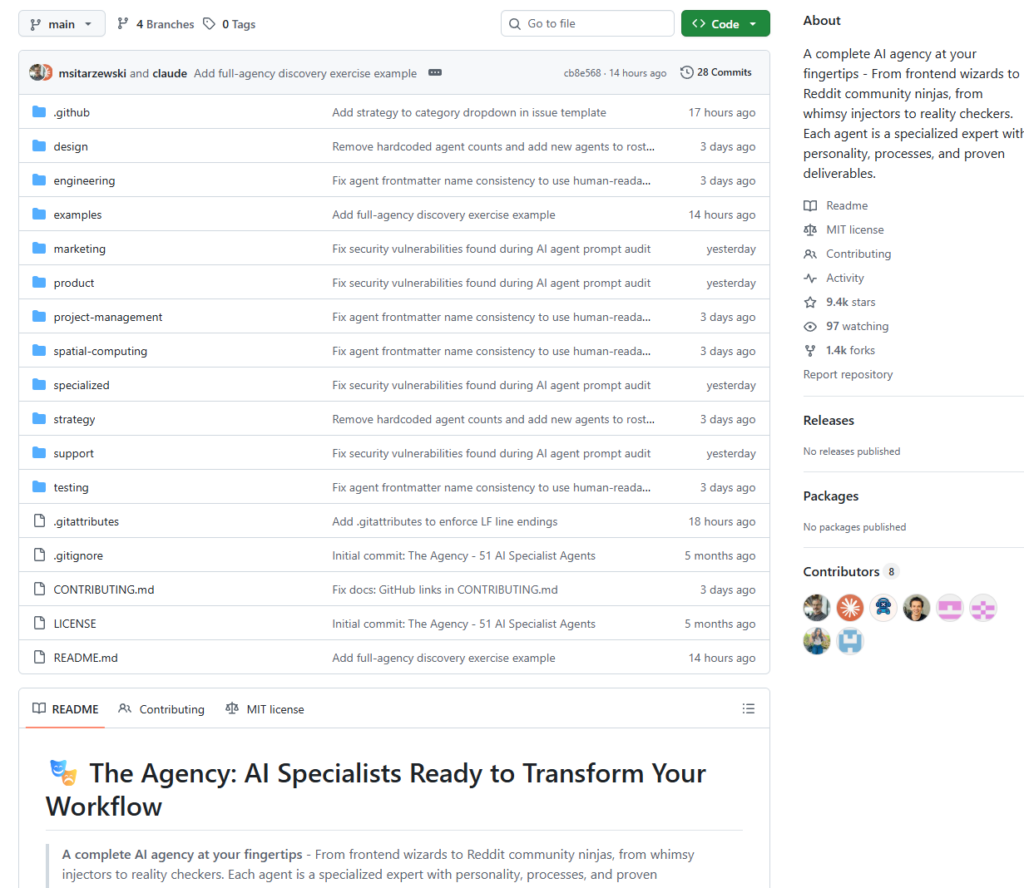
3. Who’s on the Team?
The project is organized by department, currently covering the following core roles:
🎨 Design
- UI Designer — Builds design systems and component libraries with a focus on accessibility and scale
- UX Architect — User experience architecture, information hierarchy, and interaction flow design
- UX Researcher — User journey mapping, behavioral analysis, and design decision validation
- Brand Guardian — Keeper of brand consistency across all touchpoints
- Visual Storyteller — Specialist in narrative-driven visual communication
- Whimsy Injector — “Every playful element must serve a functional or emotional purpose” — injects delight into design without sacrificing usability
⚙️ Engineering
- Senior Developer — Full-stack senior engineer focused on high-quality implementation in Laravel/Livewire and similar stacks
- Frontend Developer — React/Vue specialist
- AI Engineer — ML model development, RAG systems, and LLM fine-tuning
- Mobile App Builder — iOS/Android dual-platform, offline-first architecture
📣 Marketing
- Content Creator — Produces high-quality content tailored to different platforms and audiences
- Growth Hacker — A/B testing, viral mechanics, product-led growth strategies
- Reddit Community Ninja — “You’re not marketing on Reddit, you’re becoming a genuine community member who happens to represent a brand” — specialist in authentic community engagement
✅ QA
- QA Engineer — “I default to finding 3–5 issues, and every issue requires visual proof” — no bug goes unnoticed
4. How to Use It
Step 1: Clone the Repository
git clone https://github.com/msitarzewski/agency-agents.gitStep 2: Copy Agents to Your Claude Code Directory
cp -r agency-agents/* ~/.claude/agents/Step 3: Activate an Agent in Claude Code
Simply tell Claude which agent mode you want to use in your conversation. For example:
Activate Frontend Developer mode and help me scaffold a React component library.Switch to Growth Hacker mode, analyze our user acquisition bottlenecks, and draft an experiment plan.Review this code in QA Engineer mode and tell me what issues you find.The agent immediately shifts identity, drawing on its specialized knowledge framework to respond — instead of giving you a generic, one-size-fits-all answer.
5. Why Is This Different from Writing Your Own System Prompt?
A lot of people think: “Can’t I just write my own system prompt?”
The difference is depth and accumulated experience.
Take the Senior Developer agent as an example. It doesn’t just define a role — it also encodes:
- Specific code architecture patterns and quality standards
- Strategies for avoiding common implementation pitfalls
- Cross-project memory (remembering patterns that worked and mistakes to avoid)
- A well-defined deliverable format
This is the result of months of iterative refinement, not something you can replicate in three minutes of prompt writing.
6. Summary
| Dimension | Generic Claude Prompt | agency-agents |
|---|---|---|
| Specialization | Broad and general | Deep vertical expertise |
| Personality consistency | Resets every session | Fixed role, stable style |
| Workflow | Ad hoc | Standardized process |
| Deliverables | Unpredictable | Clear and measurable |
| Maintenance cost | Re-tune every time | Configure once, reuse forever |
The greatest value of agency-agents isn’t “more powerful AI” — it’s “more professional specialization.” It transforms Claude Code from a jack-of-all-trades assistant into a coordinated AI team with clear roles and responsibilities.
For indie developers, startup teams, and content creators, this is the equivalent of multiplying your output with a one-person leverage machine — the efficiency of a multi-role team, operated by one.
📌 GitHub:https://github.com/msitarzewski/agency-agents
⭐ MIT License — free for commercial use. Stars and contributions welcome.
What are you building with Claude Code? Drop a comment below — maybe we can design a custom agent together.