Forget GPU Anxiety: Microsoft BitNet Runs LLMs on an Ordinary CPU
Think you need a high-end GPU to run a large language model locally? Microsoft just proved otherwise — with one open-source project.
The Problem We’ve All Been Dealing With
Over the past few years, large language models have grown remarkably capable — but running them locally has only gotten harder:
- Memory explosion: A 7B-parameter model at FP16 precision alone eats up roughly 14 GB of VRAM
- Hardware dependency: Consumer GPUs like the RTX 3060 12G struggle the moment models get any larger
- High power consumption: A single inference run burns through significant electricity — edge devices simply can’t handle it
- Privacy concerns: Sending sensitive data to the cloud is something many users and organizations want to avoid entirely
In short: modern LLMs are too heavy for ordinary people to run.
Quantization has long been the standard workaround — compressing 16-bit float weights down to 8-bit or 4-bit. But that’s still just trimming at the edges, and precision loss is always lurking.
Microsoft’s answer is far more radical: compress weights down to 1.58 bits, right from the start.
What Is BitNet?
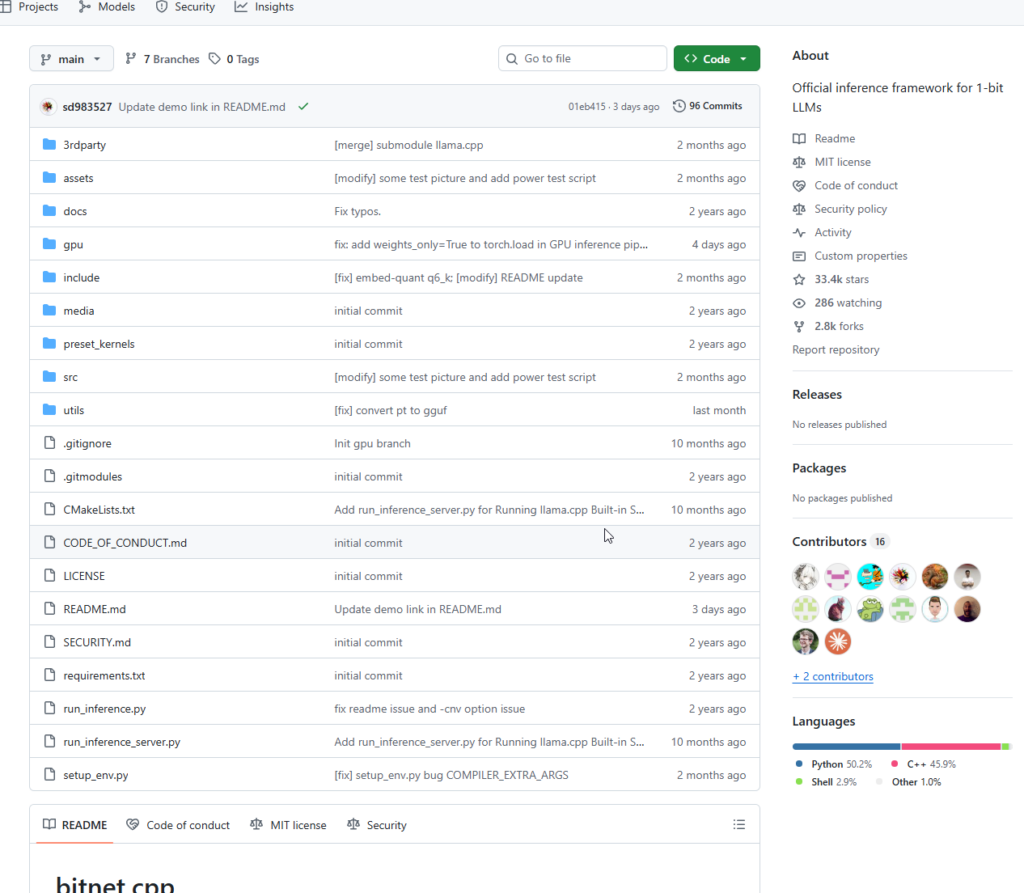
BitNet is Microsoft’s official open-source inference framework for 1-bit large language models. The core project is bitnet.cpp, available on GitHub at microsoft/BitNet.
Its companion model is BitNet b1.58 — the “b1.58” is a mathematical fact: when you represent weights as ternary values (−1, 0, or +1), each weight requires only $\log_2 3 \approx 1.58$ bits on average.
This is not ordinary post-training quantization. It is a 1-bit model trained natively from scratch.
Core Technical Highlights
| Feature | Description |
|---|---|
| Ternary weights | Weights can only be −1, 0, or +1, implemented via absmean quantization |
| 8-bit activations | Ultra-minimal weights paired with 8-bit activation precision for a balance of efficiency and expressiveness |
| Multiplication-free inference | Ternary arithmetic reduces matrix multiplication to additions and subtractions — friendly to CPUs by design |
| Dedicated inference kernels | Deeply customized on top of llama.cpp, further accelerated with T-MAC lookup table techniques |
The flagship model, BitNet b1.58 2B4T (2 billion parameters, trained on 4 trillion tokens), is currently the world’s first open-source native 1-bit large language model, released in 2025.
How Good Is It, Really?
Comparison with Full-Precision Models of Similar Scale
BitNet b1.58 2B4T requires only 0.4 GB of memory for non-embedding weights, while comparable full-precision models typically need 1.4–4.8 GB. Decoding latency on CPU is just 29 ms per token, with energy consumption as low as 0.028 J per inference.
On the GSM8K mathematical reasoning benchmark, BitNet scores 58.38 — surpassing both Qwen2.5 and MiniCPM while using dramatically fewer computational resources.
Inference Performance Gains
On x86 CPUs, BitNet delivers 2.37×–6.17× faster inference and 71.9%–82.2% lower energy consumption compared to full-precision equivalents. A 100B-parameter BitNet b1.58 model can run on a single CPU at roughly 5–7 tokens per second — close to natural human reading speed.
Bottom line: Less than 1/10th the memory of a standard model. Equal or better results.
How to Use It
Requirements
- Python 3.9+
- CMake 3.22+
- Clang 18+ (recommended) or GCC
- Windows users: Visual Studio 2022
Quickstart (5 Steps)
Step 1 — Clone the repository
git clone --recursive https://github.com/microsoft/BitNet.git
cd BitNet
Step 2 — Create environment and install dependencies
conda create -n bitnet-cpp python=3.9
conda activate bitnet-cpp
pip install -r requirements.txt
Step 3 — Download the model
huggingface-cli download microsoft/BitNet-b1.58-2B-4T-gguf \
    --local-dir models/BitNet-b1.58-2B-4T
Step 4 — Configure the build environment
python setup_env.py -md models/BitNet-b1.58-2B-4T -q i2_s
Step 5 — Run inference
python run_inference.py \
    -m models/BitNet-b1.58-2B-4T/ggml-model-i2_s.gguf \
    -p "You are a helpful assistant" \
    -cnv
⚠️ One Critical Note
You must use the dedicated bitnet.cpp inference framework to realize the efficiency gains. Loading and running the model directly through HuggingFace Transformers — without the specialized kernels — may result in speed and energy performance no better than a full-precision model, or even worse.
Who Is This For?
Great fit:
- Local knowledge bases and private deployments — data never leaves the machine
- Edge device AI — Raspberry Pi, low-power NAS, industrial controllers
- Developer research — an experimental platform for 1-bit LLM training and inference
- Resource-constrained servers — inference without any GPU at all
Less suitable for:
- Production commercial use — official guidance recommends thorough testing before any business application
- Multilingual scenarios — non-English language support remains limited at this stage
Conclusion
BitNet isn’t a patch or an optimization — it represents a genuine paradigm shift in how large models are designed:
Rather than asking “how do we squeeze a large model into less memory,” the question becomes “what if the model was designed to be lightweight from day one?”
When a 2B-parameter model needs only 0.4 GB of memory and runs smoothly in conversation on an ordinary CPU, the barrier to local AI is no longer the price of a graphics card. Smartphones, routers, industrial controllers — devices that were never “supposed” to run language models may soon be doing exactly that.
Microsoft has opened the door. Larger parameter models, broader multilingual support, NPU acceleration — all of it is on the horizon. The 1-bit era has only just begun.
GitHub: https://github.com/microsoft/BitNet
Model download: Search microsoft/bitnet-b1.58-2B-4T on HuggingFace
Live demo: aka.ms/bitnet-demo