The Problem: Why Is Fine-Tuning So Hard?
Fine-tuning a large language model sounds like a dream — take a general-purpose model and turn it into a domain expert for legal documents, customer support, code generation, or anything else you need.
But reality hits hard:
- Massive VRAM requirements: Full fine-tuning a 7B-parameter model demands 40GB+ of VRAM — completely out of reach for consumer GPUs
- Painfully slow training: Even with LoRA and quantization, a single training epoch under the native HuggingFace framework takes forever
- Steep learning curve: From data preparation and model loading to training configuration and export, every step is a potential minefield
- Hardware gatekeeping: Most tutorials assume you have an A100 — if you’re on an RTX 3060, you’re left out
These barriers have locked a technology that should be universally accessible behind a door that only a privileged few can open.
What Is It?
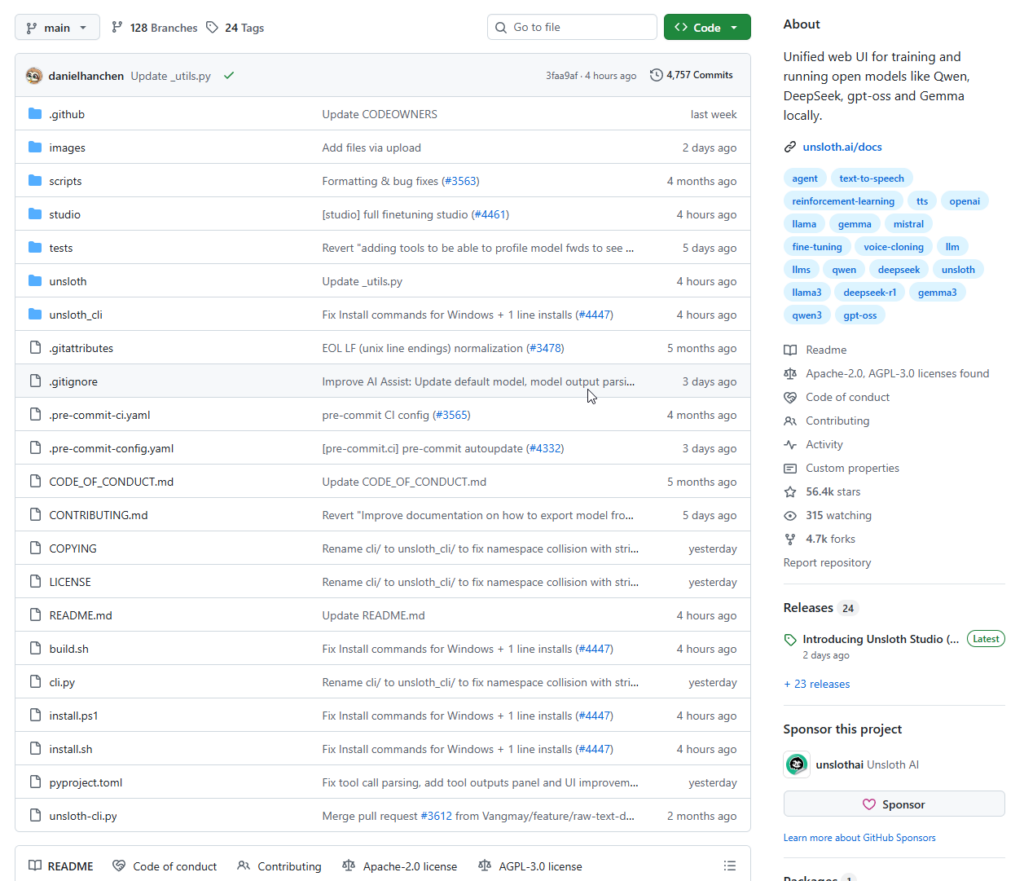
Unsloth is an open-source framework purpose-built for LLM fine-tuning and local inference optimization. Founded by brothers Daniel Han and Michael Han, it launched in 2023 and has since accumulated nearly 50,000 GitHub Stars.
Its mission statement is simple: let anyone fine-tune large models on their own hardware.
All compute kernels are written in OpenAI’s Triton language, paired with a hand-crafted backpropagation engine that delivers speed gains with zero accuracy loss — no approximations, no compromises — without requiring any hardware upgrades.
Key numbers:
- Training speed up to 12× faster on MoE (Mixture-of-Experts) architectures, with 35% less VRAM
- Supports 4-bit and 16-bit QLoRA / LoRA fine-tuning, compatible with bitsandbytes
- Runs on NVIDIA GPUs from 2018 onwards (CUDA Capability 7.0+: RTX 20/30/40 series, V100, T4, A100, H100, and more)
- Compatible with 500+ models including Qwen, DeepSeek, Gemma, Llama, Mistral, and Phi
Beyond fine-tuning, trained models can be exported as safetensors or GGUF format for use directly with llama.cpp, vLLM, Ollama, and other inference runtimes — forming a complete train-to-deploy pipeline.
Core Features
1. Blazing-Fast LoRA / QLoRA Fine-Tuning
This is Unsloth’s flagship capability. Through custom Triton kernels and hand-written backpropagation, it dramatically reduces VRAM usage and accelerates training — without sacrificing any accuracy.
Take an RTX 3060 (12GB VRAM) as an example: fine-tuning Llama-3.1-8B is simply impossible with the native HuggingFace stack. With Unsloth’s 4-bit QLoRA, the same task runs smoothly on the same GPU.
2. Reinforcement Learning (RL) Support
Unsloth supports GRPO reinforcement learning for long-context reasoning, capable of replicating DeepSeek-R1’s “aha moment” with as little as 5GB of VRAM — turning models like Llama, Phi, and Mistral into reasoning-capable systems. For developers exploring o1-style reasoning enhancement, this is one of the lowest-barrier entry points available.
3. Unsloth Studio — Visual Web UI
Unsloth now ships with a unified web UI that lets you run and train open-source models like Qwen, DeepSeek, gpt-oss, and Gemma locally — no coding required. Data preparation, model training, and inference comparison are all handled through the interface.
The Data Recipes feature enables a graphical node-based workflow for converting unstructured documents — PDFs, CSVs, JSON files — into training-ready datasets.
4. Dynamic GGUF Quantization
Unsloth’s Dynamic GGUF 2.0 applies different quantization precision to different layers, striking a better balance between model size and inference quality. It has become one of the most-downloaded sources for quantized models.
5. Multi-Modal and Multi-Task Support
Unsloth supports inference and training across text, audio, embeddings, vision, and TTS model types — far surpassing its original identity as “just an LLM fine-tuning tool.”
How to Use It
Option 1: pip Install
# Install uv (recommended package manager)
curl -LsSf https://astral.sh/uv/install.sh | sh

# Create a virtual environment
uv venv unsloth_env --python 3.13
source unsloth_env/bin/activate

# Install unsloth (auto-detects torch backend)
uv pip install unsloth --torch-backend=auto
Option 2: Launch Unsloth Studio (Web UI)
unsloth studio setup
unsloth studio -H 0.0.0.0 -p 8888
Then open http://localhost:8888 in your browser.
Option 3: Docker
docker run -d \
  -e JUPYTER_PASSWORD="mypassword" \
  -p 8888:8888 -p 8000:8000 -p 2222:22 \
  -v $(pwd)/work:/workspace/work \
  --gpus all \
  unsloth/unsloth
Option 4: Code-First Fine-Tuning (Most Flexible)
A minimal example fine-tuning Llama-3.1-8B with Unsloth:
from unsloth import FastLanguageModel
import torch

# Load model (4-bit quantized to save VRAM)
model, tokenizer = FastLanguageModel.from_pretrained(
    model_name="unsloth/Meta-Llama-3.1-8B-Instruct-bnb-4bit",
    max_seq_length=2048,
    load_in_4bit=True,
)

# Add LoRA adapters
model = FastLanguageModel.get_peft_model(
    model,
    r=16,                  # LoRA rank
    target_modules=["q_proj", "k_proj", "v_proj", "o_proj",
                    "gate_proj", "up_proj", "down_proj"],
    lora_alpha=16,
    lora_dropout=0,
    bias="none",
)

# Continue with TRL's SFTTrainer for training...
After training, export to GGUF for Ollama in one line:
model.save_pretrained_gguf("my_model", tokenizer, quantization_method="q4_k_m")
Free Notebooks (No Local GPU Needed)
Unsloth provides free Google Colab and Kaggle Notebooks that deliver 2× or more fine-tuning speedups on a single NVIDIA GPU — completely free. If you don’t have a local GPU, the official Notebooks are the fastest way to get started. The team maintains over 250 templates covering different models and tasks.
Supported Models
| Family | Representative Models |
|---|---|
| Meta Llama | Llama 3.1 / 3.2 / 3.3 / 4 |
| Alibaba Qwen | Qwen2.5 / Qwen3 / Qwen3-Coder |
| DeepSeek | DeepSeek-R1 / DeepSeek-V3 / DeepSeek-OCR |
| Gemma 2 / 3 | |
| Microsoft | Phi-4 / BitNet |
| Mistral AI | Mistral / Mistral Small |
| OpenAI | gpt-oss (open-source version) |
| Moonshot AI | Kimi K2 / K2.5 |
Summary
Unsloth solves a fundamental democratization problem: bringing LLM fine-tuning capability — once the exclusive domain of well-resourced organizations — within reach of consumer-grade GPUs.
Its core value comes down to three things:
- Extreme efficiency: Speed and VRAM improvements come from ground-up kernel rewrites, not parameter tweaks — they are systemic, not incidental
- Zero accuracy loss: Unlike some acceleration approaches that rely on approximations, Unsloth guarantees training results identical to the original
- Complete toolchain: From dataset construction and model training to RL fine-tuning, quantized export, and local deployment — one framework covers the entire workflow
For developers who have a consumer GPU (RTX 3060 or better) and want to fine-tune open-source models for a specific domain, Unsloth is the most compelling framework to reach for first.
GitHub: https://github.com/unslothai/unsloth Documentation: https://unsloth.ai/docs Official Notebooks: https://github.com/unslothai/notebooks