Claude Flow: Command an AI Engineering Team to Write Your Code
One developer writes code while AI assists with the thinking. An AI team writes code while you only define the requirements. Claude Flow is built to make the latter a reality.
⭐ 14,200+ GitHub Stars · 🐝 87 MCP Tools · 🤖 64 Specialist Agents · ⚡ Hive-Mind Architecture
1. What Problem Does It Solve?
Claude Code is already impressively capable — but it’s fundamentally a solo operator. You give it a task, it works through it sequentially, you wait, it delivers.
When the task gets complex enough, that model starts to crack:
Complex projects require multiple specialized roles. A proper full-stack feature needs an architect to design the system, a backend engineer to build the API, a frontend engineer to build the UI, a QA engineer to write test cases, and a security engineer to review the code. In a real team, these roles run in parallel. In a single-thread AI conversation, everything queues up serially — slow, and prone to losing context along the way.
The context window is a hard ceiling. As conversations grow longer, the model becomes increasingly forgetful. Early architectural decisions, dependency choices, and structural patterns gradually fade from its awareness.
No memory means starting from scratch every time. A project that spans multiple days requires re-explaining the entire background every time you open a new conversation. The AI doesn’t know what happened yesterday or why the previous version was written the way it was.
No parallelism. Frontend and backend could absolutely be developed simultaneously — but a single-thread AI can only do one thing at a time, burning hours on pure wait time.
Claude Flow was built to break through all of these constraints. Its answer is simple: if one AI isn’t enough, deploy a whole swarm of them.
2. What Is Claude Flow?
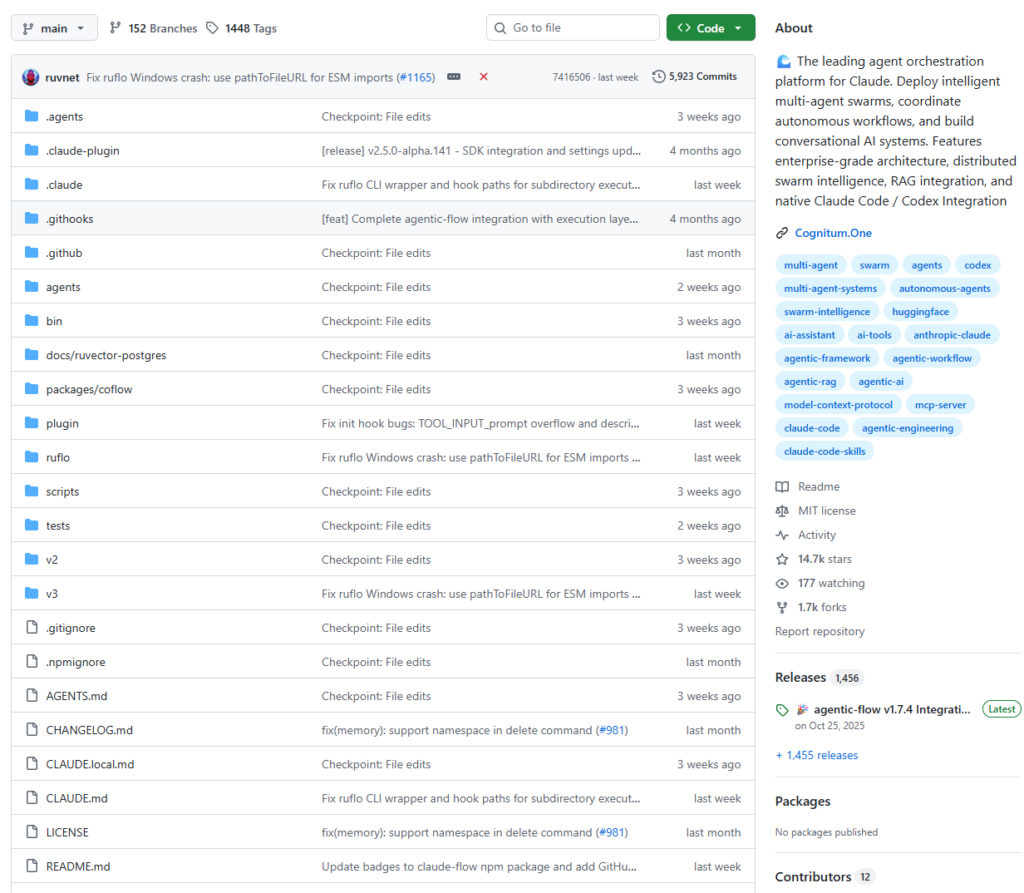
Claude Flow is a Claude-powered Multi-Agent Orchestration Platform, with over 14,200 GitHub Stars and a bold claim of being the “#1 agentic coding framework.”
Its core idea: decompose complex development tasks and distribute them across multiple specialized AI agents running in parallel. These agents coordinate through a shared memory system, collectively accomplishing work that far exceeds what any single AI context window could handle.
Think of it as equipping Claude Code with a full project management system, a team collaboration layer, and persistent long-term memory.
Technically, it integrates natively with Claude Code via the Model Context Protocol (MCP), exposing 87 MCP tools, 64 specialist agents, and a “Hive-Mind” collective intelligence architecture.

3. Core Capabilities
🐝 Swarm Multi-Agent Orchestration
The signature capability of Claude Flow. Just describe a task — the system automatically analyzes its complexity, assembles the right roster of specialist agents (architect, backend engineer, frontend engineer, QA tester, security auditor…), assigns work according to a chosen topology, and runs all agents in parallel through a shared coordination context.
Two classic topology options:
- Hierarchical — A Queen Agent acts as the master coordinator, decomposing the task and dispatching sub-tasks to specialized Worker Agents. Best for large projects with a clear primary thread of work.
- Mesh — All agents communicate as peers with no central authority. Best for tasks that require mutual review and iterative cross-validation across multiple agents.
🧠 Persistent Memory System
Traditional AI conversations have no memory across sessions. Claude Flow introduces AgentDB, an SQLite-backed store that persists architectural decisions, code patterns, debugging insights, and project context to a local .swarm/memory.db file.
After each completed step, agents automatically write their “experience” to the memory store. On the next startup, the system reads the history and restores context — as if your AI team never left the project.
The latest version also introduces ReasoningBank with semantic search, letting agents query memory in natural language rather than by exact key names.
🔌 87 MCP Tools + 64 Specialist Agents
87 MCP tools cover every operational surface: swarm initialization, agent scheduling, performance monitoring, memory read/write, and topology optimization.
The 64 specialist agents span 16 categories, including:
- Code:
coder,code-reviewer,refactorer,debugger - Testing:
tester,performance-benchmarker,integration-tester - Security:
security-auditor,vulnerability-scanner - Architecture:
system-architect,api-designer - DevOps:
cicd-engineer,production-validator - Docs:
documentation-writer,api-docs
Each agent carries a dedicated system prompt and a defined capability boundary — no agent bleeds into another’s domain.
📡 Stream-JSON Real-Time Pipeline
Introduced in v3, Stream-JSON Chaining lets agents pipe their output directly to the next agent without waiting for full completion. A research agent that discovers an API design pattern immediately pushes that finding to the coding agent to begin implementation, while the test agent simultaneously starts scaffolding test fixtures — all three progressing at once.
According to the project’s own benchmarks, this is 40–60% faster than traditional file-based handoffs.
✅ Truth Verification
A newer mechanism that adds an accuracy verification layer requiring each agent’s output to pass a 0.95 confidence threshold before being accepted, with automatic rollback on failure. Combined with Pair Programming mode — where two agents review each other’s work in real time — this significantly reduces AI hallucination in generated code.
4. How to Use It
Installation
Prerequisites — install Claude Code first:
npm install -g @anthropic-ai/claude-code
Then install Claude Flow:
# Recommended — one-line install script
curl -fsSL https://cdn.jsdelivr.net/gh/ruvnet/claude-flow@main/scripts/install.sh | bash

# Or via npx (no global install required)
npx claude-flow@alpha init

# Or install globally
npm install -g claude-flow@alpha
⚠️ Alpha Stage: Claude Flow is actively developed and some features are still stabilizing. Check the GitHub releases page for the latest version before installing.
Step 1 — Initialize Your Project
Run the following in your project directory:
npx claude-flow@alpha init
This creates:
.claude/directory (agent configs, skills, commands)CLAUDE.mdproject behavior specification- MCP server config auto-injected into Claude Code
- All 87 MCP tools immediately available in Claude Code sessions
Step 2 — Launch a Swarm Task
# 8 agents build a REST API with authentication in parallel
claude-flow swarm "Build REST API with authentication" --agents 8

# Hierarchical swarm for a structured project
claude-flow hive init --topology hierarchical --agents 6

# Mesh topology for collaborative review tasks
claude-flow hive init --topology mesh --agents 4
Step 3 — Use Directly Inside Claude Code
After initialization, just type your request naturally inside a Claude Code session — the MCP tools activate automatically:
"Build a full-stack app with user management and OAuth authentication using 6 agents"
Claude Code auto-invokes mcp__claude-flow__swarm_init, assembles the agent team, and begins parallel execution.
Step 4 — Monitor Swarm Status
claude-flow hive status
Example output:
🐝 Swarm Status: ACTIVE
├── 🏗️  Topology: hierarchical
├── 👥 Agents: 6/8 active
├── ⚡ Mode: parallel execution
├── 📊 Tasks: 12 total (4 complete, 6 in-progress, 2 pending)
└── 🧠 Memory: 15 coordination points stored
Step 5 — Work With Persistent Memory
# Store an architectural decision
claude-flow memory store "architecture/decisions" "Using microservices with Redis cache"

# Recall across sessions
claude-flow memory recall "architecture/*"

# Semantic search
claude-flow memory search "authentication pattern" --limit 5
Step 6 — Use SPARC Mode for Structured Development
SPARC (Specification → Pseudocode → Architecture → Refinement → Completion) drives the agent team through a standard software engineering process:
# Build a REST API with the full SPARC flow
claude-flow sparc run api "user management API with OpenAPI docs"

# TDD-first development
claude-flow sparc run tdd "shopping cart feature"

# Full-stack build
claude-flow sparc run dev "build complete e-commerce platform"
5. Summary
Claude Flow represents a more ambitious paradigm shift in AI-assisted development: moving from “you pair-programming with an AI” to “you directing an AI engineering team.”
It’s still in Alpha, and installation reliability and some features are actively being polished. For small tasks or single-file edits, the overhead is probably not worth it.
But if you’re dealing with:
- A medium-to-large project requiring multiple specialized roles
- Multi-day continuous development where rebuilding context every session is painful
- A goal of having AI drive work autonomously rather than confirming each step with you
…then the swarm architecture, persistent memory, and parallel execution that Claude Flow provides are among the most complete open-source answers to those problems available today.
Over 14,000 Stars, an active release cadence, and growing community adoption suggest this isn’t just an experiment — it’s a direction the field is heading.
GitHub: https://github.com/ruvnet/claude-flow
The age of AI writing code is already here. The age of AI teams writing code is what Claude Flow is building toward.