The era of AI sovereignty is here. Mozilla’s subsidiary MZLA Technologies has launched a new open-source AI client that takes direct aim at ChatGPT Enterprise, Microsoft Copilot, and Claude Enterprise.
What Problem Does It Solve?
If your organization is currently using ChatGPT Enterprise or Microsoft Copilot, consider this question carefully:
Where is your internal data right now?
Every time an employee asks an AI a question — every contract, financial report, or snippet of code uploaded for review — that data quietly flows to the servers of OpenAI, Microsoft, or Anthropic. You are not just paying for a SaaS subscription; you are feeding your most critical business assets into someone else’s model.
MZLA CEO Ryan Sipes put it plainly:
“When you rely on these big proprietary providers, you’re just renting a critical part of your organization’s operations.”
This is the problem Thunderbolt was built to solve — the question of data sovereignty and AI control.
What Is Thunderbolt?
Thunderbolt is an open-source, self-hostable enterprise AI client developed by MZLA Technologies — the Mozilla subsidiary behind the Thunderbird email client. It is designed as a unified AI workspace where employees interact with AI through chat, search, and research workflows, while the models, data, and infrastructure remain entirely under the organization’s control.
Core Features
| Feature | Details |
|---|---|
| 🧠 Free model choice | Supports commercial providers (OpenAI, Anthropic, Mistral, OpenRouter) as well as local inference via Ollama or llama.cpp |
| 🔒 Data stays in-house | Fully private deployment with optional end-to-end encryption and device-level access controls |
| 🌐 All-platform coverage | Web, Windows, macOS, Linux, iOS, and Android |
| 🔗 Open protocol integrations | Supports MCP (Model Context Protocol), ACP (Agent Client Protocol), and deepset’s Haystack for RAG and agent orchestration |
| 📋 Multiple work modes | Chat / Search / Research (preview) / Tasks (preview) |
| 🔄 Workflow automation | Generate daily briefings, monitor topics, compile reports, and trigger scheduled actions |
| 🏢 Enterprise identity | OIDC support — connects with Keycloak and other enterprise SSO providers |
| 📜 Open-source license | Mozilla Public License 2.0 — business-friendly |
In one sentence: Thunderbolt is a self-hosted, open-source replacement for ChatGPT Enterprise — but you own everything.
How to Use It
Option 1: Quick Start with Docker Compose (Recommended for Beginners)
Ideal for local testing and small team evaluation. You can be up and running in minutes.
# 1. Clone the repository
git clone https://github.com/thunderbird/thunderbolt.git
cd thunderbolt

# 2. Copy the environment variable template
cp deploy/.env.example deploy/.env

# 3. Start all services
docker compose -f deploy/docker-compose.yml up -d
Once running, open http://localhost in your browser, create an account, and you’re ready to go.
⚠️ Note: The current version still relies on online authentication services. A fully offline mode is in development.
Option 2: Local Model Inference (Zero Cost)
The official recommendation for free, private inference is Ollama or llama.cpp:
# Install Ollama and pull a model
ollama pull llama3

# In Thunderbolt's settings, add a model provider:
# URL: http://localhost:11434
# Protocol: OpenAI Compatible
All inference requests run locally — your data never leaves the machine.
Option 3: Connect to Commercial APIs
Navigate to Settings → Model Providers and enter your API key for any of the following:
- OpenAI (GPT-4o and others)
- Anthropic (Claude series)
- Mistral
- OpenRouter (multi-provider aggregator)
Option 4: Kubernetes for Enterprise Production
For organizations requiring high availability, Thunderbolt ships complete Kubernetes manifests and Pulumi Infrastructure-as-Code support for AWS Fargate and EKS:
cd deploy/k8s
./up.sh   # Deploy to your Kubernetes cluster
Connecting Enterprise Data (RAG)
Thunderbolt uses deepset’s Haystack framework for Retrieval-Augmented Generation (RAG), enabling employees to query internal knowledge directly:
- Connect Google Drive and Microsoft document stores
- Integrate custom data sources via MCP servers
- Vector search with automatic agent orchestration
How Does It Compare?
| Thunderbolt | ChatGPT Enterprise | Microsoft Copilot | |
|---|---|---|---|
| Data ownership | ✅ Fully yours | ❌ Flows to OpenAI | ❌ Flows to Microsoft |
| Model lock-in | ✅ Freely switch | ❌ GPT only | ❌ OpenAI/Microsoft only |
| Deployment | ✅ On-prem or cloud | ❌ Cloud only | ❌ Cloud only |
| Open source | ✅ MPL 2.0 | ❌ Proprietary | ❌ Proprietary |
| Cost | ✅ Free (self-hosted) | 💰 Per-seat pricing | 💰 Per-seat pricing |
| Production readiness | ⚠️ In development | ✅ Mature | ✅ Mature |
Current Status and Caveats
It’s important to be transparent: Thunderbolt is still in early development. The official README is unusually candid about this:
- A security audit is currently underway — not recommended for production use yet
- Currently depends on online authentication services; fully offline mode is a roadmap item
- Telemetry is enabled by default (can be opted out)
- Primarily targeted at enterprises with the technical capacity to self-host
That said, the project already has over 1,400 GitHub stars within days of launch, community interest is high, and the development pace is rapid.
Conclusion
Ryan Sipes frames Thunderbolt as a “Firefox moment” for enterprise AI — just as Firefox broke Internet Explorer’s browser monopoly, he wants Thunderbolt to challenge OpenAI and Microsoft’s grip on the enterprise AI front door.
The analogy resonates. As AI becomes deeply embedded in enterprise operations, who controls the data and who controls the model selection will be among the most consequential infrastructure decisions an organization can make.
Thunderbolt deserves serious attention from organizations in these situations:
- 🏥 Heavily regulated industries with strict data compliance requirements (finance, healthcare, government)
- 🏭 Technology and manufacturing companies that cannot afford proprietary knowledge to leave their perimeter
- 🛡️ Any enterprise looking to reduce SaaS dependency and build independent, long-term AI capabilities
The code is available now. The audit is in progress. The timing, for those with the patience to evaluate early-stage infrastructure software, could not be better.
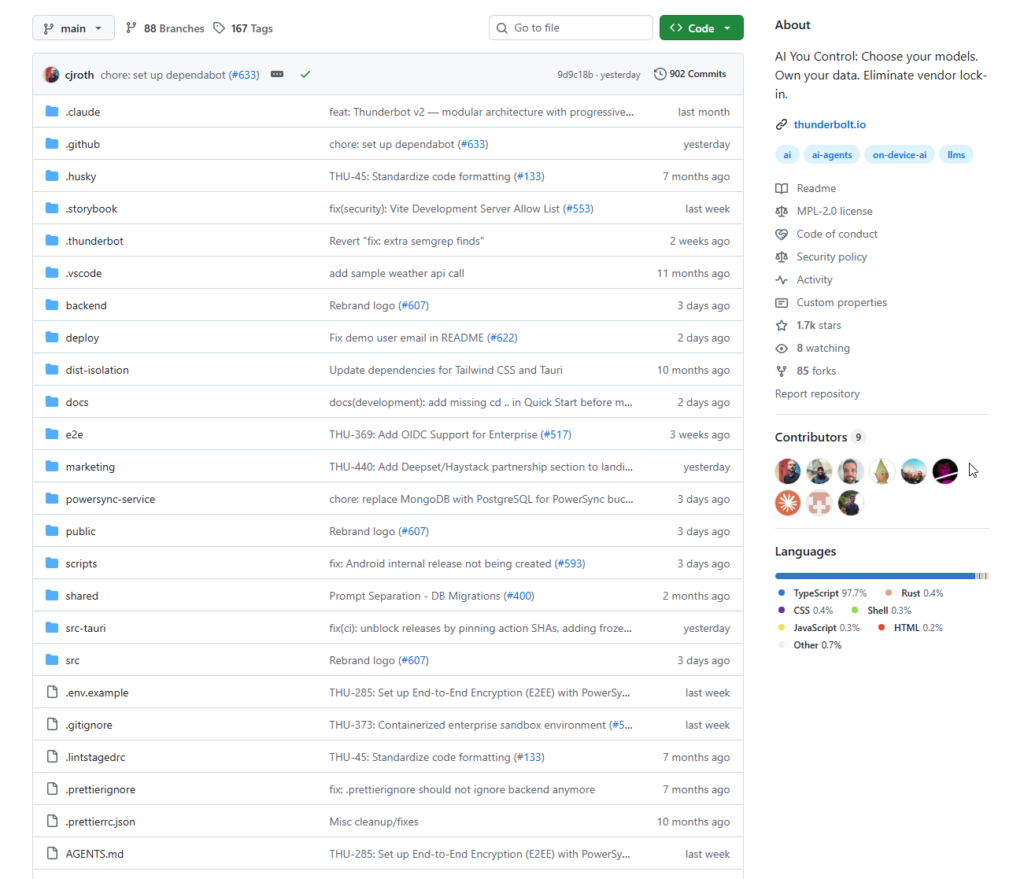
📦 GitHub: https://github.com/thunderbird/thunderbolt
🌐 Official site: https://thunderbolt.io
Is your organization thinking about AI data sovereignty? Leave a comment below — we’d love to hear how you’re approaching it.