TL;DR: Rowboat is an open-source, AI-assisted multi-agent builder — essentially the Cursor for AI agents. Describe what you need in plain English, and its built-in Copilot automatically generates, wires up, and deploys a full multi-agent system for you.
1. What Problem Does It Solve?
AI agents have been the hottest topic in tech over the past two years, and LLM application frameworks have multiplied accordingly. Yet developers hitting production consistently run into three hard walls:
Complex to build, steep learning curve
Standing up a production-ready multi-agent system means manually defining each agent’s role, writing prompt instructions, configuring tool-call chains, and handling handoff logic between agents. Every step demands hard-won experience and is easy to get wrong.
Painful iteration, debugging in the dark
Once an agent’s instructions grow complex, changing one line can break everything else. Without proper tooling you can’t even tell: which agent made that decision? Which tool did it call? What did it actually return?
Fragile integration, prototype-to-production gap
Even after you’ve got the logic working, wiring your agent system into a real application is another slog — especially without a clean, standard API surface.
Rowboat’s core insight: building a multi-agent system is structurally similar to writing code — decompose, compose, test, iterate. If Cursor can do that for code, why not have a “Cursor for agents”?
2. What Is Rowboat?
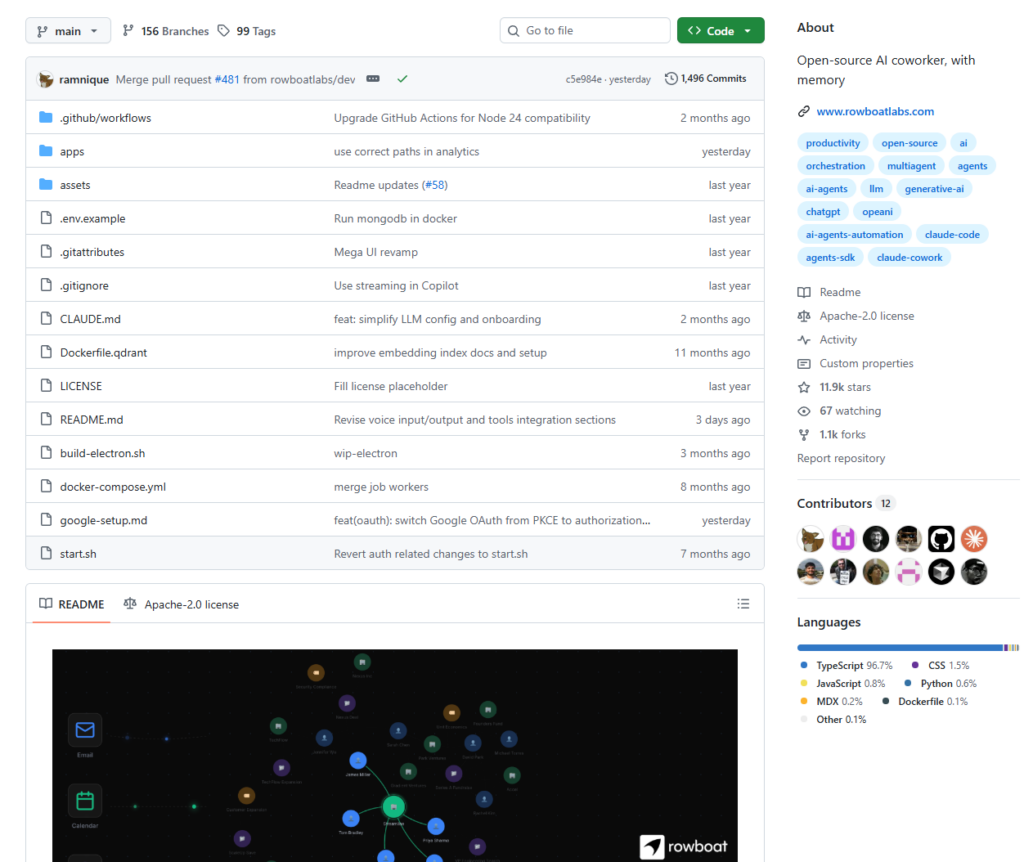
Rowboat is an open-source AI multi-agent IDE built by RowBoat Labs on top of OpenAI’s Agents SDK. As of April 2026 it has surpassed 10,400 GitHub stars and continues to grow fast.
The team’s credentials are solid: co-founders Arjun, Ramnique, and Akhilesh previously built Agara, an AI customer-support startup acquired by Coinbase in 2021. After the acquisition they led the build-out of Coinbase’s automated support system and have published research and hold patents across LLMs, reinforcement learning, and embeddings. They are a Y Combinator-backed company.
The project is licensed under Apache 2.0 — fully self-hostable and completely free.
Feature overview
| Module | What it does |
|---|---|
| 🤖 Copilot builder | Describe your requirements in plain language; Copilot auto-generates the multi-agent workflow |
| 🔧 Visual Studio | Code-editor-style prompt management with @mentions syntax for agents, tools, and reusable prompts |
| 🧪 Playground debugger | Watch agent handoffs, tool invocations, and responses in real time |
| 🌐 MCP tool integration | Connect any MCP server to extend agent capabilities |
| 📞 Multiple integration paths | HTTP API, Python SDK, web widget, or Twilio phone number |
| ☁️ One-command deployment | Full Docker Compose setup — up and running in minutes |
Why multi-agent beats single-agent
The Rowboat team makes a clear case for multi-agent architectures in real-world workloads:
- Higher instruction-following accuracy — narrower instructions per agent means the model is less likely to get confused
- More reliable tool calls — each agent has a small, specific toolset, reducing selection errors
- Easier maintenance and testing — changes to one agent can be isolated and tested without disturbing the rest of the system
It mirrors the single-responsibility principle in good software design: a codebase of well-scoped functions beats one giant function crammed with everything.
3. How to Use It
Step 1 — Spin up the local service (under a minute)
# Set your OpenAI API key
export OPENAI_API_KEY=your-openai-api-key

# Clone the repo
git clone git@github.com:rowboatlabs/rowboat.git
cd rowboat

# Start all services
docker-compose up --build
Open http://localhost:3000 in your browser to enter Rowboat Studio.
Step 2 — Describe your requirements in plain English
Type your use case into the Copilot chat, for example:
“Build me a customer support assistant for a food-delivery platform that can handle delivery-status queries and missing-item complaints, with the necessary tools included.”
Copilot will automatically:
- Plan how many sub-agents are needed (e.g. a routing agent, a delivery-status agent, a complaints agent)
- Generate structured instruction prompts for each agent
- Design the handoff logic between agents
- Recommend which tools to connect
Every change is presented as a code-style diff, so nothing is hidden from you.
Step 3 — Debug live in the Playground
Once built, test directly inside Studio’s Playground:
- Start a conversation and watch which agent is responding
- Inspect the full tool-call chain and its return values
- If something’s off, just tell Copilot: “It shouldn’t have handled it that way — please fix this.”
Copilot uses the conversation context to locate the problem and update the relevant agent’s instructions.
Step 4 — Connect MCP tools to extend capabilities
Add MCP servers in settings to pull external capabilities — search engines, databases, CRMs, internal APIs — into your agent system. Reference tools directly inside agent instructions using the @tool-name syntax to control exactly when they fire.
Step 5 — Integrate into your application via API or SDK
HTTP API:
curl --location 'http://localhost:3000/api/v1/<PROJECT_ID>/chat' \
  --header 'Content-Type: application/json' \
  --header 'Authorization: Bearer <API_KEY>' \
  --data '{
    "messages": [{"role": "user", "content": "Where is my order?"}],
    "state": null
  }'
Python SDK:
from rowboat import Client, StatefulChat

client = Client(
    host="http://localhost:3000",
    project_id="<PROJECT_ID>",
    api_key="<API_KEY>"
)

# Recommended: stateful chat session
chat = StatefulChat(client)
response = chat.run("Where is my food delivery order?")
print(response)
Install in one line: pip install rowboat
4. Use Cases
- Enterprise customer support — handle multiple query types and automatically route complex issues to the right specialist agent
- Business process automation — multi-agent workflows for cross-system approval chains and data processing pipelines
- Employee assistants — internal knowledge Q&A, HR queries, IT ticketing, and more
- Data analysis workflows — specialized agents collaborating across data collection, cleaning, analysis, and report generation
5. Summary
Rowboat’s value proposition is straightforward: it lowers the bar for building multi-agent systems from “requires expert experience” to “describe your requirements clearly in plain English.”
This isn’t just another LLM wrapper library. It’s a complete multi-agent development IDE — with tooling for every stage from design and build through debugging to production deployment. For engineering teams exploring AI agent adoption, Rowboat is one of the most serious open-source options worth evaluating right now.
One caveat worth noting: the current version is built primarily on OpenAI’s Agents SDK, and support for other LLM providers is still being worked on (a community fork for OpenRouter already exists). If your stack doesn’t depend on OpenAI, it’s worth keeping an eye on upcoming releases.
GitHub: https://github.com/rowboatlabs/rowboat
Docs: https://docs.rowboatlabs.com/
License: Apache 2.0
GitHub Stars: 10.4k+ (April 2026)
If you found this useful, share it with a developer friend who’s building with AI agents.