A framework for building agents you can actually see, understand, and trust.
1. The Problem: Why Is Multi-Agent Development So Hard?
If you’ve been building AI Agent applications recently, you’ve probably run into at least one of these frustrations:
- The black-box problem: What is the agent actually thinking? Which tools did it call? Why did it return that result? There’s no visibility into any of it.
- Coordination chaos: How do multiple agents communicate? How do you manage shared state without everything falling apart? One wrong move and the whole system becomes unmanageable.
- The production gap: It runs perfectly on your laptop — then breaks the moment you deploy it. Autoscaling, monitoring, fault tolerance: each one is its own mountain to climb.
- Reinventing the wheel, constantly: Memory modules, tool-calling, prompt management — built from scratch every single time. The inefficiency compounds fast.
These pain points are manageable with a single agent. Once your system grows, they become a full-time nightmare. AgentScope was built specifically to solve them.
2. What Is AgentScope?
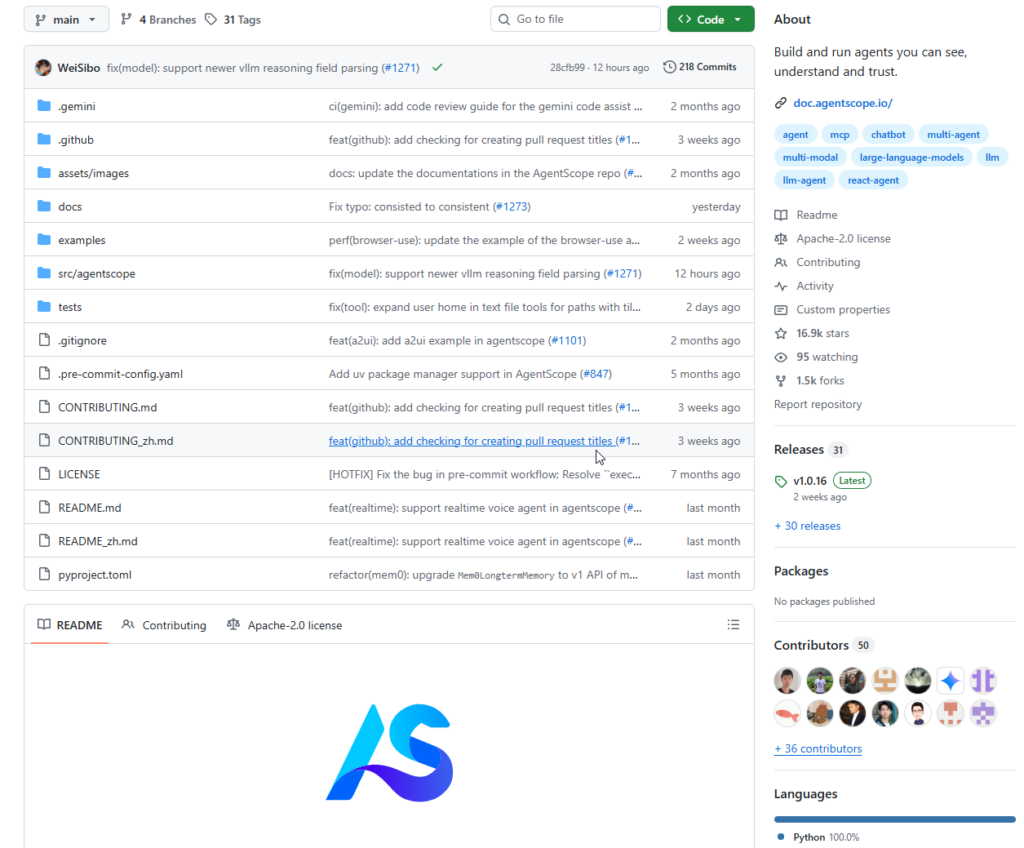
AgentScope is an open-source multi-agent framework for developers, released by Alibaba and now boasting over 16,000 GitHub Stars.
Its core philosophy is captured in one sentence:
Build and run agents you can see, understand and trust.
AgentScope isn’t just another thin wrapper around an LLM API. It’s a complete engineering system from development to production, covering the full lifecycle of agent-based application development:
| Module | What It Does |
|---|---|
| AgentScope (Core Framework) | Build agents, tool calling, multimodal support, multi-agent orchestration |
| AgentScope Runtime | Production deployment, secure sandboxing, Agent-as-a-Service API |
| AgentScope Studio | Visual development environment, debug monitoring, built-in Copilot |
| AgentScope Samples | Ready-to-use examples from CLI tools to full-stack applications |
It supports both Python and Java, making it a strong fit for everyone from solo developers to enterprise engineering teams.
3. Core Capabilities, Broken Down
🔍 1. Transparent, Observable Agents
AgentScope’s most emphasized feature is making every agent step visible. Developers can fully trace an agent’s prompt content, memory state, API calls, and tool usage — no more staring at a black box wondering what went wrong. This alone can save hours during debugging and production incident investigation.
🤝 2. Flexible Multi-Agent Collaboration
The framework provides MsgHub and Pipeline mechanisms that make message routing between multiple agents clean and straightforward.
from agentscope.pipeline import MsgHub, sequential_pipeline
from agentscope.message import Msg
import asyncio

async def multi_agent_conversation():
    # Create multiple agents
    agent1 = ...
    agent2 = ...
    agent3 = ...

    # Manage conversation through a central message hub
    async with MsgHub(
        participants=[agent1, agent2, agent3],
        announcement=Msg("Host", "Please introduce yourselves in turn.", "assistant")
    ) as hub:
        # Execute sequentially
        await sequential_pipeline([agent1, agent2, agent3])

        # Dynamically manage participants
        hub.add(agent4)
        hub.delete(agent3)

asyncio.run(multi_agent_conversation())
Agents interact through explicit message passing rather than implicit shared state, making behavior far more predictable.
⚡ 3. Up and Running in 5 Minutes
AgentScope ships with built-in support for ReAct agents, memory management, tool calling, human-in-the-loop, voice conversation, model fine-tuning, and evaluation — no need to build infrastructure from scratch.
pip install agentscope
from agentscope.agent import ReActAgent

agent = ReActAgent(
    name="Friday",
    sys_prompt="You are a professional AI assistant.",
    model=model
)

# Register a hook to intercept and extend agent behavior
agent.register_instance_hook(
    "pre_reply",
    "log_response",
    my_pre_reply_hook
)
🏭 4. Production-Grade Deployment
Many agent frameworks stop at the demo stage. AgentScope is designed for real production environments:
- Secure sandboxing: Python, shell, browser, and other tools execute in isolated environments to contain risk.
- Agent-as-a-Service: Wrap agents as standard APIs with support for the A2A protocol and OpenAI-compatible interfaces.
- Kubernetes & Serverless deployment: Built-in OpenTelemetry support, natively cloud-native.
- State persistence: Redis-based session management with long-term memory that survives across sessions.
🛠️ 5. Rich Ecosystem Integrations
- Tool protocols: MCP (Model Context Protocol) and A2A protocol
- Memory framework: ReMe — modular memory management with cross-agent and cross-user memory reuse
- LLM providers: DashScope (Tongyi), OpenAI, Gemini, Anthropic, and other major APIs
- RAG frameworks: Compatible with LlamaIndex and LangChain
4. How to Use It: Three Real-World Scenarios
Scenario 1: Deep Research Assistant
The agentscope-samples repository includes a ready-to-deploy deep research agent. Multiple agents collaborate to handle information retrieval, analysis, and report generation in a complete end-to-end pipeline. A full-stack Runtime version is available for direct deployment.
Scenario 2: Werewolf Game (Multi-Agent Strategy)
The framework ships with a role-playing multi-agent game example that demonstrates complex inter-agent communication, strategic reasoning, and dynamic role management. It’s also an excellent stress test for validating agent collaboration capabilities.
Scenario 3: EvoTraders — Financial Trading Agents
A team of specialized analyst agents covers fundamental, technical, sentiment, and valuation analysis. Combined with the ReMe memory framework, each agent reflects on and learns from every trading decision, continuously improving — with a full visualization dashboard to track everything in real time.
5. How Does It Compare?
| Feature | AgentScope | LangChain | AutoGen |
|---|---|---|---|
| Multi-agent collaboration | ✅ Native, MsgHub mechanism | ⚠️ Requires extra config | ✅ Supported |
| Production deployment | ✅ Runtime + K8s | ⚠️ Limited | ⚠️ Limited |
| Visual debugging | ✅ AgentScope Studio | ⚠️ Third-party tools | ⚠️ Limited |
| Java support | ✅ Native Java SDK | ❌ None | ❌ None |
| Model fine-tuning | ✅ Built-in support | ❌ None | ❌ None |
| Learning curve | ⭐⭐⭐ Moderate | ⭐⭐⭐⭐ Steeper | ⭐⭐⭐ Moderate |
6. Conclusion
AgentScope bridges the gap between an AI agent that technically runs and one that actually works in production.
It doesn’t optimize for the simplest possible API. Instead, it invests deeply in engineering completeness: transparent debugging, structured multi-agent coordination, reliable production deployment, and memory and tool management that holds up under real workloads.
AgentScope is worth a serious look if you are:
- An engineer building complex agent applications who needs robust multi-agent orchestration
- A team with production deployment requirements who needs an observable, ops-friendly framework
- An enterprise AI developer who needs Java support or integration with existing infrastructure
If you’re writing a simple LLM script, AgentScope might feel like more than you need. But once your system starts to grow, you’ll be glad you picked a framework that can take you all the way to production.
GitHub: https://github.com/agentscope-ai/agentscope
Official Site: https://agentscope.io