Rehearsing the Future in a Digital Sandbox — MiroFish: A Collective Intelligence Prediction Engine
Upload a single file. It builds a parallel world and predicts what happens next.
01 The Limits of Traditional Prediction
Every day we face questions that demand a glimpse of the future: How will a viral controversy unfold? How will the public react once a new policy takes effect? What really happened in the lost chapters of a classic novel?
Traditional forecasting methods — whether statistical models or single-instance AI conversations — share one fundamental flaw: they reduce the world to a linear trajectory. In reality, the genuine driver of how events evolve is the constant, tangled interaction of countless individuals.
The problem with conventional AI is that it is a solitary chat window. Real-world change, by contrast, is collective emergence — thousands of people negotiating, spreading information, and making decisions simultaneously. That gap is exactly what MiroFish is built to close.
If a single AI model is only 30% accurate, what could one million of them predict together?
02 What Is MiroFish?
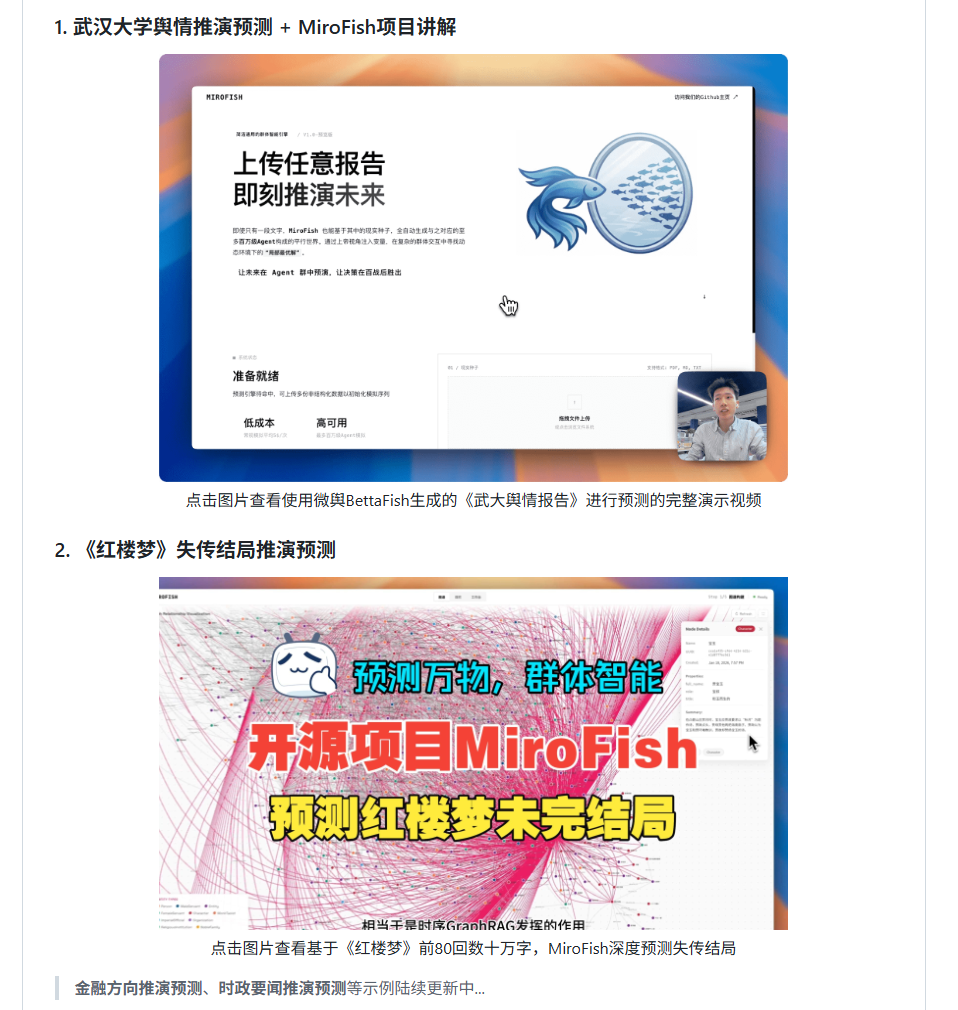
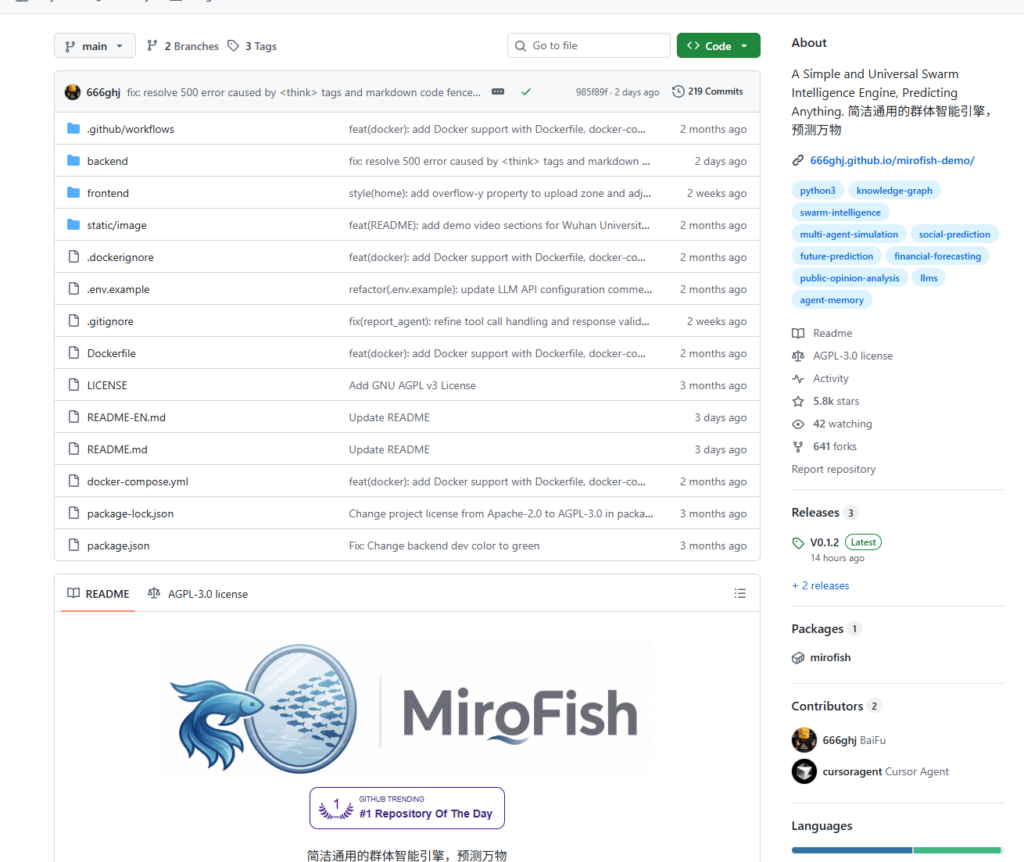
MiroFish is a next-generation AI prediction engine powered by multi-agent technology, open-sourced on GitHub and incubated by Shengda Group. The project launched in December 2025 and quickly climbed to the top of GitHub Trending.
Its core idea: use real-world information as a “seed” to automatically construct a high-fidelity parallel digital world. Inside that world, thousands of agents — each equipped with a distinct persona, long-term memory, and behavioral logic — interact freely, giving rise to complex social dynamics.
Key capabilities at a glance:
- 🌱 Seed-Driven Simulation — Upload any material, from a news report to a novel excerpt, and it becomes the starting point of a parallel world.
- 🧠 Long-Term Memory — Built on GraphRAG + Zep Cloud, every agent carries its own social memory and behavioral history.
- 🔭 God-Mode Observation — Inject variables dynamically and watch how butterfly effects ripple through the virtual society.
- 📊 Deep Reporting — ReportAgent synthesizes simulation results into structured, detailed predictive analysis reports.
The simulation engine is powered by OASIS, an open-source framework from the CAMEL-AI team that supports concurrent interaction among millions of agents. It has already been used in academic research on topics like misinformation diffusion and the social impact of recommendation algorithms.
03 How to Use It
Getting started with MiroFish involves two steps: local deployment and launching a prediction. The barrier to entry is low, and Docker one-command startup is fully supported.
Requirements: Node.js 18+, Python 3.11+, and an LLM API key (the project recommends Alibaba Cloud Model Studio, though other major providers are also supported).
# 1. Clone the repository
git clone https://github.com/666ghj/MiroFish
cd MiroFish

# 2. Configure your API key
cp .env.example .env
# Edit .env and add your LLM API key

# 3. Start with Docker (recommended)
docker compose up -d

# Open http://localhost:3000 in your browser
Once deployed, open the web interface and the entire prediction pipeline runs automatically across four stages:
Stage 1 — Knowledge Graph Construction The system extracts entities and relationships from your seed material, using temporal GraphRAG to build a dynamic knowledge graph that faithfully reconstructs the event background and social network.
Stage 2 — Environment Setup Entity relationships are automatically parsed to generate agents with diverse stances and backgrounds. Simulation parameters are injected through an Agent layer, completing the “world-building” phase of the virtual society.
Stage 3 — Dual-World Parallel Simulation Agents make decisions powered by large language models and run in parallel across two simulated platforms, autonomously generating social behaviors — posting, liking, interviewing — while continuously updating their temporal memory.
Stage 4 — Report Generation & Deep Interaction ReportAgent conducts an in-depth analysis of the simulation output and produces a comprehensive predictive report. Users can also step directly into the digital world and converse with any agent.
⚠️ Watch your token costs: A full simulation run consumes a significant number of LLM tokens. It is recommended to start with a small-scale test of fewer than 40 rounds using a free-tier API quota. Free quotas from most providers may not cover a complete run, so budget accordingly.
All you need to do is two things: upload your seed material (a data report, a news article, even a fiction text), then describe the question you want predicted in plain language. MiroFish handles the rest.
The project also ships with a companion tool called BettaFish, which automatically scrapes public opinion data from 30+ platforms — including Xiaohongshu, Douyin, and Weibo — generates an analysis report, and feeds it directly into MiroFish, forming a complete data collection → intelligent prediction pipeline.
Typical use cases:
| Scenario | How It Works |
|---|---|
| 📰 Public Opinion Forecasting | Upload a sentiment report; simulate how a story spreads across social strata and how opinion shifts over time |
| 📈 Financial Decision Sandbox | Inject market signals and draft policies; simulate market reactions across different decision paths |
| 🏛️ Policy Dry-Run | Test a policy’s real-world impact in a zero-risk environment; observe how public sentiment evolves |
| 📖 Narrative Continuation | Feed in the first 80 chapters of Dream of the Red Chamber; let the agent collective infer the lost ending |
04 Summary
MiroFish represents a significant direction for large-model Agent applications: from the solitary assistant to the social collective. It is not yet another “conversational AI” — it is a simulation engine that assembles thousands of AIs into a society, lets them evolve autonomously, and surfaces predictions through emergence.
The underlying idea is not new — social simulation and agent-based modeling have deep roots in academia. MiroFish’s contribution is making these ideas engineered, productized, and accessible to everyday users, giving the eternal question “what if we had made a different decision?” a concrete, runnable answer for the first time.
Who is MiroFish for?
- Decision-makers who need a low-risk environment for testing different strategies
- Researchers who want to explore social emergence phenomena
- Creators who want AI assistance in world-building and narrative design
- The curious — anyone who has ever wondered about parallel possibilities
That said, current limitations are worth acknowledging: simulation results are indicative rather than definitive, a single run can be costly, and complex scenarios may require substantial processing time. As an open-source project, however, both the technical architecture and the engineering implementation are well worth studying.
One sentence to remember it by: MiroFish is a digital sandbox engine that uses collective intelligence to predict the future — upload any seed material, let millions of AI agents evolve freely inside a parallel world, and receive a detailed predictive report at the end. It turns the eternal “what if?” into an experiment you can run in code.
⭐ GitHub: github.com/666ghj/MiroFish